BBC:
The World Health Organisation has declared a polio outbreak in Papua New Guinea and called for an “immediate” vaccination campaign.
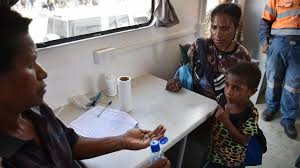
Samples of the highly infectious virus were found in two healthy children during a routine screening in Lae, a coastal city in the country’s north east.
Less than half of the country’s population are immunised against the potentially deadly disease, which is close to being wiped out but has recently resurfaced in some parts of the world.
“We have to do something about it and we have to do it immediately,” said Sevil Huseynova, WHO’s representative in Papua New Guinea, warning that the disease could spread beyond the country.
“We have to make maximum effort to get 100% [vaccination] coverage,” Dr Huseynova said at a media conference on Thursday.
“Polio knows no borders.”
The disease is caused by the poliovirus, which spreads through contact with an infected person’s faeces or droplets when they cough and sneeze.
It mostly affects children under five years old.
There is no cure for polio, although the majority of people with the infection – including the two recent cases in Papua New Guinea – have no symptoms. Those who do may get a flu-like illness.
A small number of people infected with polio – between one in a thousand and one in a hundred – develop more serious problems that can lead to paralysis. This is also when the disease becomes life-threatening, particularly when paralysis affects muscles used for breathing.
Papua New Guinea was said to be polio-free since 2000, until an outbreak in 2018, which was contained within the same year.
The latest cases were found to be carrying a virus strain genetically linked to one circulating in Indonesia. Papua New Guinea shares a border with Indonesia’s easternmost Papua province.
Health Minister Elias Kapavore has vowed to achieve 100% polio immunisation in the country by the end of this year.
“There is no excuse… Polio is a serious disease,” he said.
The ongoing campaign will target children aged 10 and below and is expected to reach around 3.5 million people.
“The battle on polio starts today,” the department wrote in a Facebook post yesterday.
The WHO, UN’s children agency Unicef and Australia’s government are supporting Papua New Guinea in its rollout of vaccines.
Unicef’s Papua New Guinea representative Veera Mendonca pointed out the disparity in vaccination coverage across the country – with coverage as low as 8% in some districts.
“That is not acceptable,” she said, adding that Unicef is working with churches and community leaders to encourage vaccination and to dispel any misinformation.
Polio has staged a comeback elsewhere in Asia in recent years. Pakistan saw 74 cases of the disease last year, while Afghanistan recorded 24 cases.
The WHO has also warned of an outbreak in war-torn Gaza after traces of the virus were found in wastewater.