BBC:
For much of my life, walking in Indian cities has felt less like exercising a right than negotiating an obstacle course.
I grew up in Kolkata, where wide pavements disappeared beneath rows of hawkers. I moved to Delhi, where roads seemed designed almost exclusively for cars. Now I live in Gurugram, where footpaths vanish into rubble and garbage, are abruptly blocked by parked vehicles or construction, or sit uncomfortably high above the road.
So when India’s Supreme Court declared in June that the right to walk safely on designated footpaths was a fundamental right, it felt less like judicial activism than common sense arriving decades late.
Walking is the most democratic form of transport. Yet it is also the one India’s cities have neglected most consistently.
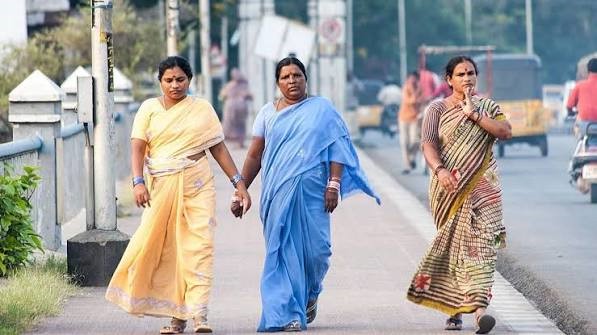
It’s remarkable because India remains, above all, a nation of walkers. Around 45 million people walk to work every day, according to census-based estimates, compared with only about 5.4 million who commute in private cars, jeeps or vans.
Nearly a third of urban workers walk to work, while virtually every bus or metro journey begins and ends on foot. Add school runs, shopping trips and other everyday journeys, and walking dominates urban mobility. A 2019 survey of selected cities found that 63% of all journeys were made on foot, making pedestrians the single largest group of road users.
Many are what researchers call “captive pedestrians” – people who walk not by choice but because they cannot afford another option. Women are especially dependent on walking. Yet the people who contribute least to congestion and pollution often face the greatest risks.
The evidence is harrowing. Even where pavements exist, they are often broken, narrow or inaccessible to older people, children and those with disabilities.
They are also blocked by motorcycles, swallowed by parked cars, encroachments or excavated for utility works. Faded zebra crossings are treated as little more than road markings no-one respects. Flyovers speed traffic while forcing pedestrians into hazardous detours below.
A landmark 2011 study of six Indian cities found that India’s streets routinely fail pedestrians because of “poor and unsafe” infrastructure.
The Walkability in Indian Cities report by the Clean Air Initiative for Asian Cities (CAI-Asia) gave the surveyed cities a median walkability score of just 47 out of 100, with the worst conditions around public transport terminals – ironically the places where most journeys begin and end on foot
As Geetam Tiwari, a transport scholar at Indian Institute of Technology (IIT) Delhi puts it, pedestrians have been “pushed to the margins of the road networks” forcing them to “jostle for space with motor vehicles”.
The price is paid in lives.
Officially pedestrians account for roughly a fifth of road deaths, but independent studies cited by Tiwari estimate the share is closer to 30-40%.