BBC:
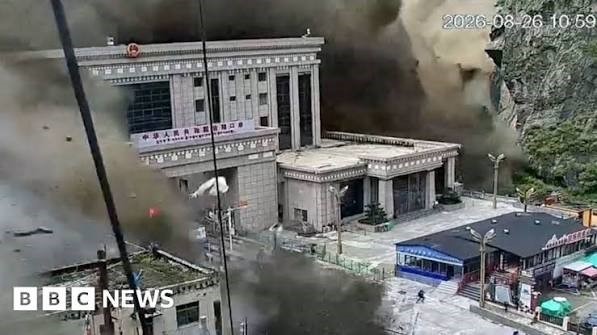
The dramatic footage was almost impossible to miss. A torrent of water tearing through Gyirong Port, one of the main border crossings between Nepal and Tibet, sweeping away all in its path as hundreds of people fled for their lives.
The scenes, captured by CCTV cameras, quickly spread on social media and onto screens around the world.
Except here, in China.
Only a single still-frame shot has been broadcast so far by the country’s state-run flagship news bulletin.
It has also been difficult to find the video on China’s heavily censored internet. It is just as hard to even find posts describing the flash flooding that has claimed hundreds of lives, with just as many still unaccounted for since Wednesday.
Beijing has launched a massive rescue operation involving hundreds of emergency workers, which is continuing, and President Xi Jinping chaired an emergency meeting with officials to co-ordinate efforts.
But when you compare the country’s internet content to what much of the world has been seeing online these past few days, China’s firewall becomes more visible than ever.
Tibet, which Beijing annexed in the 1950s, had long resisted rule by the Chinese Communist Party.
China has quashed protests over the years, sometimes violently, and has been accused of grave rights violations in the Buddhist region. It has labelled the exiled spiritual leader, the Dalai Lama, a separatist.
That history means the very name Tibet draws China’s censors. Beijing’s sensitivities are especially apparent at times likes this.
There have been daily updates on the missing and the dead, and Beijing has also been posting updates on the rescue operations, as well as the dangers posed by a barrier lake that has been at risk of overflowing.
But there is little detail beyond that. There are no accounts from survivors in Tibet, and almost no user-generated footage showing the deadly moments or their aftermath.
We are yet to hear from anxious families of those missing. Trying to contact people there is near-impossible during regular times.
As a journalist who has covered North Korea, it has often been easier for me to contact interviewees in Pyongyang than it is in the Tibetan capital, Lhasa.