CNN —
Xi Jinping has appealed to Vietnam to join China in upholding multilateral trade, as he begins a high-stakes diplomatic tour of the region’s major export-reliant economies in a bid to position his country as a stable partner in contrast to the United States.
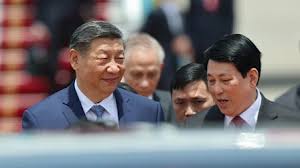
The Chinese leader arrived in communist-ruled Vietnam on Monday and is set to visit Malaysia and Cambodia from Tuesday to Friday – countries that have seen growing trade and investment ties with China in recent years.
The trip comes just days after US President Donald Trump paused his “reciprocal” tariffs on most countries for 90 days – narrowing the focus on his trade war squarely on China.
As Washington and Beijing exchange record-high levies, Southeast Asian nations – still catching their breath from the now-suspended US tariffs – are growing increasingly anxious about being caught in the crossfire between the world’s two largest economies.
Seeking to capitalize on the turmoil unleashed by Trump’s tariff whiplash, Xi is expected to cast China as a reliable partner and defender of global trade. Vietnam and Cambodia were among the highest hit by Trump’s tariffs, set at 46% and 49% respectively before the pause.
But while countries are rolling out the red carpet for Xi, they also need to tread carefully – and avoid the appearance they are siding with China, and potentially risk provoking Trump during their own negotiations over pending tariffs.
Some are wary of being flooded with cheap Chinese goods that are now shut out of the US markets due to the sky-high tariffs. China already runs a trade surplus with Vietnam, exporting 1.6 times the value it imports from its southern neighbor.
As a bloc, the Association of Southeast Asian Nations has overtaken the US and the European Union as China’s largest export market since 2023, according to Chinese customs data.
In a signed article published Monday in Vietnam state media, Xi reiterated that there are no winners in a trade war or tariff war, and protectionism will lead nowhere.
“Our two countries should resolutely safeguard the multilateral trading system, stable global industrial and supply chains, and open and cooperative international environment,” Xi wrote, according to China’s official state news agency Xinhua.
Vietnam, a rising manufacturing powerhouse, has seen a surge in Chinese investments in recent years as manufactures move supply chains out of China to take advantage of lower labor costs and hedge against US levies. China’s trade with Vietnam nearly doubled between 2017 and 2024, making the communist state China’s biggest trade partner in Southeast Asia.
While in Hanoi, Xi is expected to further strengthen those ties. The two countries are set to sign about 40 agreements across multiple sectors – including cooperation on railways, agricultural trade and the digital and green economy, Vietnam’s Deputy Prime Minister Bui Thanh Son said on Saturday, according to Reuters.
Vietnam has approved plans to build a $8.3 billion railway linking its northern port city of Haiphong to China, which will be partially funded by Chinese loans. The country is also looking to purchase China’s homegrown mainline passenger aircraft made by Chinese state-owned planemaker COMAC.
Wen-ti Sung, a non-resident fellow at the Atlantic Council, said Xi’s high-profile visit is two pronged: economically, it’s about finding a way to diversify China’s economic footprint around the world; on the foreign policy front, it’s also aimed at pulling countries closer to China while they are unsettled by Trump’s on-and-off-again tariffs.
“What Xi is trying to do now is to go there in person. Instead of fear and pressure, Xi is going to show them love, maybe some ‘souvenirs’ along the way,” he said, referring to possible new trade deals and upgrades to their strategic partnerships.
“All these are ways for China to show that I’m on your side. It’s safe to hang out with China, especially if you’re concerned about the US.”
But relations between China and its neighbors have been strained in recent years, with tensions flaring over claims of disputed sovereignty in the South China Sea. In February, Chinese warships held live-fire drills in waters near Vietnam in the Gulf of Tonkin, known as the Beibu Gulf in China, after Hanoi published a map defining its territorial claims there.
In his signed article in Vietnam’s Nhan Dan Newspaper, Xi urged the two countries to “properly manage differences and safeguard peace and stability in our region.”
“The successful delimitation of our boundaries on land and in the Beibu Gulf demonstrates that with vision, we are fully capable of properly settling maritime issues through consultation and negotiation,” Xi was quoted as writing.