BBC:
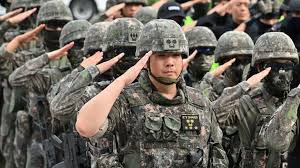
South Korea’s military has shrunk to about 450,000 people – a decline of 20% over the last six years, according to a defence ministry report released by a ruling party lawmaker on Sunday.
Authorities say the main reason behind the decline is the country’s dismal birth rate, which at 0.75 babies per woman is the world’s lowest.
South Korea retains compulsory military service mainly because the country is still technically at war with its nuclear-armed neighbour North Korea.
A study published by South Korean researchers in July had suggested that the country would need at least 500,000 soldiers to defend against an attack from the North, which is believed to have 1.3 million active-duty members.
The difference in military sizes put South Korea in a “structurally difficult position to succeed in defence”, the study said.
It also noted that South Korea needed “decisive action at the national level” to maintain at least 500,000 troops.
The number of divisions in South Korea’s military has dropped from 59 to 42 since 2006 – with units having either disbanded or merged with one another – according to the defence ministry report sent to Democratic Party lawmaker Choo Mi-ae, who made it public on Sunday.
South Korea has been increasing its defence budget in response to rising geopolitical tensions in the region. Its defence budget for 2025 stands at more than 60 trillion won ($43bn; £32bn) – more than North Korea’s GDP.
In South Korea, all able-bodied men are required to serve 18 months of military service, although rare exceptions are made – and deferments are sometimes granted.
Military service is unpopular with many men in the country, with some critics arguing that the system disrupts the careers of young men. The debate surrounding the issue has also become inextricably linked to conversations around gender equality.
Some conservatives have argued that female citizens should also be conscripted amid the country’s looming demographic crisis.
The country has repeatedly broken its own record for having the world’s lowest birth rate: 0.98 babies per woman in 2018, 0.84 in 2020, 0.72 in 2023 and 0.75 in 2024. If this trend continues, experts warn the country’s population of 50 million could halve in 60 years.