ABC:
NEW DELHI — NEW DELHI (AP) — A deadly attack on tourists in the disputed Kashmir last week has plunged relations between India and Pakistan to new lows, with both sides hinting at imminent military action.
India accuses Pakistan of backing the massacre, in which 26 men, mostly Indian Hindus, were killed, a charge Pakistan denies. Both countries have since expelled diplomats and citizens, ordered the border shut and closed their airspace for each other.
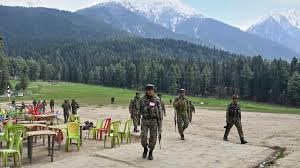
Soldiers on each side have exchanged fire along their de facto border, with each blaming the other for shooting first.
Here’s a look at multiple conflicts between the two countries since their bloody partition in 1947:
1947 — Months after British India is partitioned into a predominantly Hindu India and a Muslim-majority Pakistan, the two young nations fight their first war over control of Muslim-majority Kashmir, then a kingdom ruled by a Hindu monarch. The war killed thousands before ending in 1948.
1949 — A U.N.-brokered ceasefire line leaves Kashmir divided between India and Pakistan, with the promise of a U.N.-sponsored vote that would enable the region’s people to decide whether to be part Pakistan or India. That vote has never been held.
1965 — The rivals fight their second war over Kashmir. Thousands are killed in inconclusive fighting before a ceasefire is brokered by the Soviet Union and the United States. Negotiations in Tashkent run until January 1966, ending in both sides giving back territories they seized during the war and withdrawing their armies.
1971 — India intervenes in a war over the independence of East Pakistan, which ends with the territory breaking away as the new country of Bangladesh. An estimated 3 million people are killed in the conflict.
1972 — India and Pakistan sign a peace accord, renaming the ceasefire line in Kashmir as the Line of Control, a heavily fortified stretch of military outposts that divide the region between them. Both sides deploy more troops along the frontier, turning it into a heavily fortified stretch of military outposts.
1989 — Kashmiri dissidents, with support from Pakistan, launch a bloody rebellion against Indian rule. Indian troops respond with brutal measures, intensifying diplomatic and military skirmishes between New Delhi and Islamabad.
1999 — Pakistani soldiers and Kashmiri fighters seize several Himalayan peaks on the Indian side of the territory. India responds with aerial bombardments and artillery. At least 1,000 combatants are killed over 10 weeks and a worried world fears the fighting could escalate to nuclear conflict. The U.S. eventually steps in to mediate, ending the fighting.
2016 — Militants sneak into an army base in Indian-controlled Kashmir, killing at least 18 soldiers. India responds by sending special forces inside Pakistani-held territory, later claiming to have killed multiple suspected rebels in “surgical strikes.” Pakistan denies that the strikes take place, but it leads to days of major border skirmishes. Combatants and civilians on both sides are killed.
2019 — The two sides again come close to war after a Kashmiri insurgent rams an explosive-laden car into a bus carrying Indian soldiers, killing 40. India sends carries out air strikes in Pakistani territory, claiming to have struck a militant training facility. Pakistan later shoot down an Indian warplane and captures a pilot. He was later released, deescalating tensions.
2025 — Militants attack Indian tourists in region’s Pahalgam resort town and kill 26 men, most of them Hindus. India blames Pakistan for the attack, something Islamabad denies, and vows revenge on the attackers, sending tensions to their highest point since 2019. Both sides cancel visas of each other’s citizens, recall diplomats, shut their only land border crossing and close their airspace to each other. New Delhi also suspends a crucial water-sharing treaty with Islamabad.