ABC:
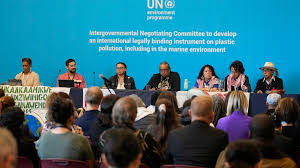
BUSAN, South Korea — The world’s nations will wrap up negotiating a treaty this weekend to address the global plastic pollution crisis.
Their meeting concludes Sunday or early Monday in Busan, South Korea, where many environmental organizations have also flocked to push for a treaty to address the volume of production and toxic chemicals used in plastic products.
Greenpeace said it escalated its pressure Saturday by sending four international activists to Daesan, South Korea, who boarded a tanker headed into port to load chemicals used to make plastics.
Graham Forbes, who leads the Greenpeace delegation in Busan, said the action is meant to remind world leaders they have a clear choice: Deliver a treaty that protects people and the planet, or side with industry and sacrifice the health of every living person and future generations.
Here’s what to know about plastics:
The use of plastics has quadrupled over the past 30 years. Plastic is ubiquitous. And every day, the equivalent of 2,000 garbage trucks full of plastic are dumped into the world’s oceans, rivers and lakes, the UN said. Most nations agreed to make the first global, legally binding plastic pollution accord, including in the oceans, by the end of 2024.
The production and use of plastics globally is set to reach 736 million tons by 2040, according to the intergovernmental Organisation for Economic Co-operation and Development.
Panama is leading an effort to address the exponential growth of plastic production as part of the treaty, supported by more than 100 countries. There’s just too much plastic, said Juan Carlos Monterrey, head of Panama’s delegation.
“If we don’t have production in this treaty, it is not only going to be horribly sad, but the treaty may as well be called the greenwashing recycling treaty, not the plastics treaty,” he said in an interview. “Because the problem is not going to be fixed.”
China was by far the biggest exporter of plastic products in 2023, followed by Germany and the U.S., according to the Plastics Industry Association.